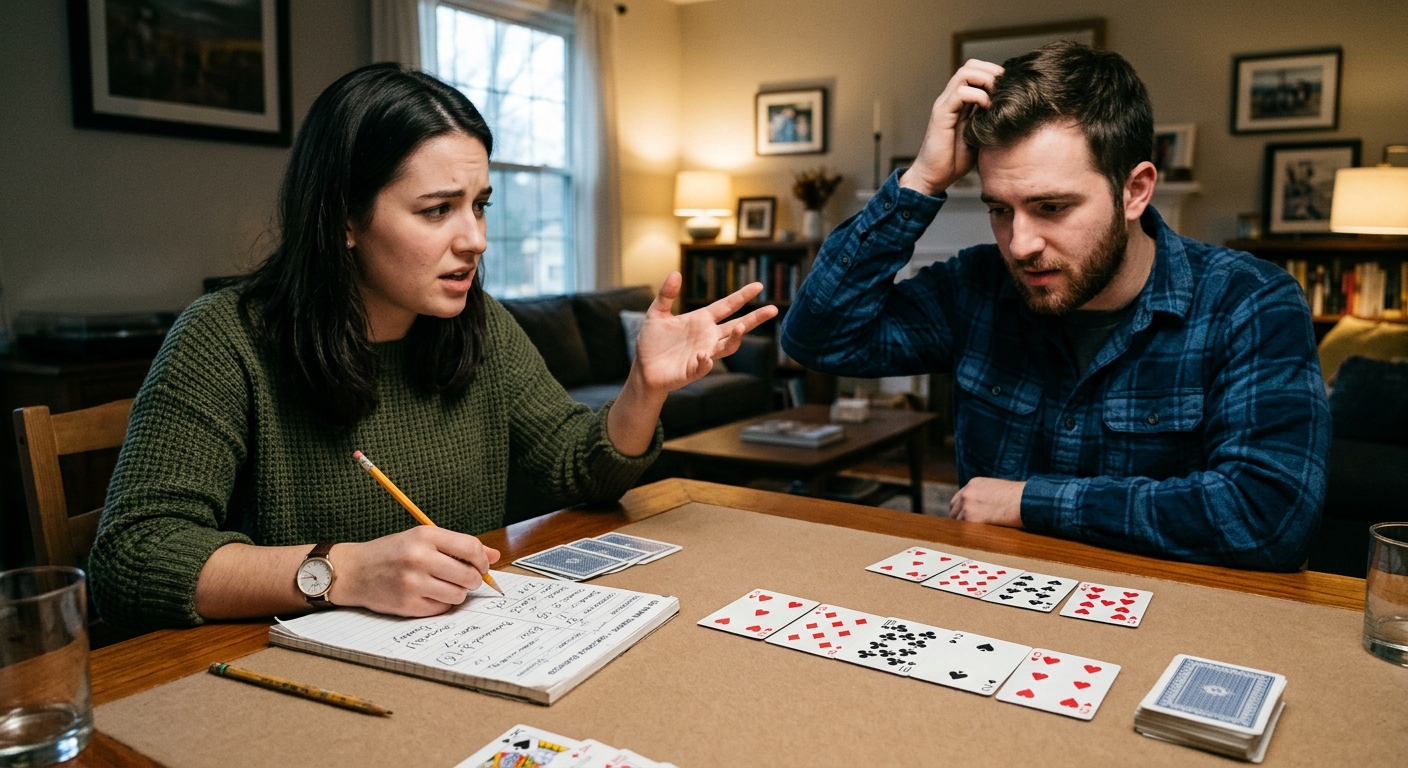
You knock with eight points, expect a small win, and watch your opponent collect the bonus instead. That surprise catches plenty of beginners. Players coming from card party games usually grasp the draw-and-discard rhythm fast. The sticking point is knowing when and why to knock. Getting below the limit gives you permission to end the hand. It does not promise that ending it will earn you points.
Before You Tap the Table
In standard gin rummy, you may knock with ten or fewer deadwood points after your discard. Your opponent then forms melds and may lay off unmatched cards onto yours. Compare the remaining deadwood totals only after that step. A tie or lower opponent total means an undercut. Gin, with zero deadwood, prevents layoffs. Check the agreed bonuses before playing, then judge each knock by both your count and the cards your opponent could attach.
Ten Points Lets You Knock, but It Does Not Guarantee a Win
A knock ends the hand and starts the scoring process. In standard gin rummy, the limit is ten deadwood points. Exactly ten qualifies. Eleven does not.
The count applies to the ten cards left after your discard. During a normal turn, you draw to eleven cards, choose a discard, and decide whether to knock based on the remaining hand. Beginners sometimes count the card they are about to throw away. Others decide they qualify before checking whether their intended discard breaks a meld.
Consider this eleven-card holding: 4, 5, and 6 of hearts; three kings; three nines; the 8 of clubs; and the queen of diamonds. Discard the queen. Your remaining ten cards contain three melds and eight points of deadwood. You may knock.
Throw away a king instead, and the result changes completely. Two kings remain, but a pair is not a meld. Those kings become deadwood alongside the eight and queen. The same draw can produce either a legal knock or a hand far above the limit, depending on your discard.
You also have a choice. Reaching ten or fewer does not force you to knock. Continuing can improve your hand, but it gives your opponent another opportunity to finish.
Count Unmatched Cards, Not Nearly Finished Melds
Deadwood consists of cards outside valid melds. A set contains three or four cards of one rank. A run contains at least three consecutive cards of one suit. Each card can belong to only one meld in your final arrangement.
Aces count as one point. Number cards count at face value. Jacks, queens, and kings each count as ten. For standard gin rummy, aces are low, meaning ace, 2, and 3 can form a run, while queen, king, and ace cannot.
That makes two tempting cards surprisingly expensive. The jack and queen of spades look close to a run, but without the 10 or king of spades, they contribute twenty deadwood points. A pair of sixes contributes twelve until a third six arrives.
Here is a complete ten-card example: 3, 4, and 5 of clubs; three sevens; 9, 10, and jack of hearts; and the ace of spades. All nine cards in the three melds contribute nothing to deadwood. Only the ace counts. Your total is one.
Do not add the values of your melded cards to your score. Their job is to remove cards from the deadwood count. The points you receive depend on the result of the hand.
One Shared Card Can Change Your Count
Suppose you hold 5, 6, and 7 of hearts, plus the 7 of clubs and 7 of diamonds. The 7 of hearts fits both a run and a set. You cannot use it in both.
Choose the heart run, and the two other sevens contribute fourteen deadwood points. Choose the set of sevens, and the 5 and 6 of hearts contribute eleven. Before accounting for any other cards, neither arrangement qualifies for a standard knock.
This is why rearranging your hand matters. A tidy-looking layout can hide a better count. Separate completed melds from hopeful combinations, then check any card that could serve two different groups.
Your Opponent Gets to Reduce Deadwood After an Ordinary Knock
The biggest scoring surprise often comes from laying off. After you knock without gin, your opponent can attach unmatched cards to your exposed melds. Those attached cards stop counting as their deadwood.
If you expose 4, 5, and 6 of hearts, an unmatched 7 of hearts can extend the run. An unmatched 3 of hearts can extend its lower end. A matching fourth card can complete a three-card set. Every attachment must preserve a valid meld.
Your opponent cannot attach a random low card merely because it would help their count. They also cannot lay off onto your unmatched cards. An exposed deadwood eight is still deadwood, not the beginning of a new run they may build.
Consider your eight-point knock from earlier. Your melds are the heart run, three kings, and three nines. Your opponent reveals three aces; 3, 4, and 5 of spades; and four unmatched cards: the 7 of hearts, 2 of clubs, 3 of diamonds, and 4 of clubs.
Their unmatched cards initially total sixteen. The 7 of hearts attaches to your run, removing seven points. Their final deadwood is nine. Your eight beats their nine, earning you just one point.
Counting before the layoff would suggest an eight-point win. Counting afterward gives the correct one-point result. Your exposed melds influence the payout as much as your own remaining card.
An Undercut Can Turn a Legal Knock Into Lost Points
Players sometimes call this “underknocking,” but the usual rules term is an undercut. It happens when your opponent finishes with deadwood equal to or below yours after permitted layoffs. A legal knock can still be undercut.
For the examples here, use a 25-point undercut bonus and a 25-point gin bonus. Gettysburg College’s scoring rules describe this North American convention, including the rule that a tied deadwood count awards the undercut to the defender. Other rule sets use different bonuses, so confirm those amounts before the first deal.
Change the opponent’s hand in the previous example. They now hold three aces; 3, 4, and 5 of spades; and the 7 of hearts, 2 of clubs, 2 of diamonds, and 3 of clubs. Their initial deadwood is fourteen.
They attach the 7 of hearts to your run. Their remaining count falls to seven. You knocked with eight, meaning they finish one point below you. With the agreed 25-point bonus, they receive 26 points. You receive none for that hand.
A tie also hurts. Knock with six against a final opposing count of six, and the difference is zero. The defender still receives the 25-point undercut bonus. Knocking first does not win a tie.
How the Same Knock Produces Different Results
| Your Finish | Opponent’s Final Deadwood | Hand Score With 25-Point Bonuses |
|---|---|---|
| Knock with 8 | 9 after layoffs | You receive 1 point. |
| Knock with 8 | 8 after layoffs | Opponent receives 25 points. |
| Knock with 8 | 7 after layoffs | Opponent receives 26 points. |
| Gin with 0 | 18, with no layoffs permitted | You receive 43 points. |
Gin Offers Protection, but Waiting Has a Cost
Gin means all ten cards left after your discard belong to melds. Your deadwood is zero. Your opponent may organize their own melds, but cannot lay off cards onto yours. You earn the agreed gin bonus plus their deadwood total.
That protection can make one more draw tempting. Suppose you hold 2, 3, and 4 of hearts; three kings; three nines; and the ace of hearts. You can knock with one point now. Drawing the 5 of hearts lets you discard the ace and finish with a four-card run, the two sets, and zero deadwood.
Waiting is not free, though. Your opponent gets another turn if you continue. They might knock, go gin, or reduce the deadwood you would have scored against.
A one-point knock is difficult to undercut because the defender must finish with one or zero. An eight-point knock gives them much more room. That does not make every low knock correct or every high knock wrong. It gives you a useful starting point for judging risk.
Pay attention to visible pickups. If your opponent took cards near an exposed run you would use, consider whether those cards could become layoffs. If the card you need for gin has already been discarded and buried, waiting for it is a weak reason to pass up a good knock.
Take Three Better Habits Into Your Next Hand
You do not need to memorize a long strategy manual to stop losing points through avoidable scoring mistakes. Build a brief routine around the moment before you discard.
Count the exact hand you will keep. Identify your melds, choose the discard, and total every remaining unmatched card. Check overlapping melds before declaring a knock. This catches pairs mistaken for sets and cards counted twice.
Inspect your melds for possible layoffs. Look at both ends of each run and any missing fourth card in a set. Treat your opponent’s visible pickups as clues. A knock near ten deserves extra thought when several cards could attach.
Give every delay a specific reason. Before passing up a legal knock, name the draw that would improve your result. Check whether it is still available. If you are waiting only because gin sounds more satisfying, reconsider the points and extra turn you are risking.
Next session, judge a knock by the count after layoffs, not by the relief of getting below ten. That small change makes the scoring easier to follow and your decisions easier to explain. You will still face uncertain hands. You will make fewer mistakes about what those hands can actually earn.