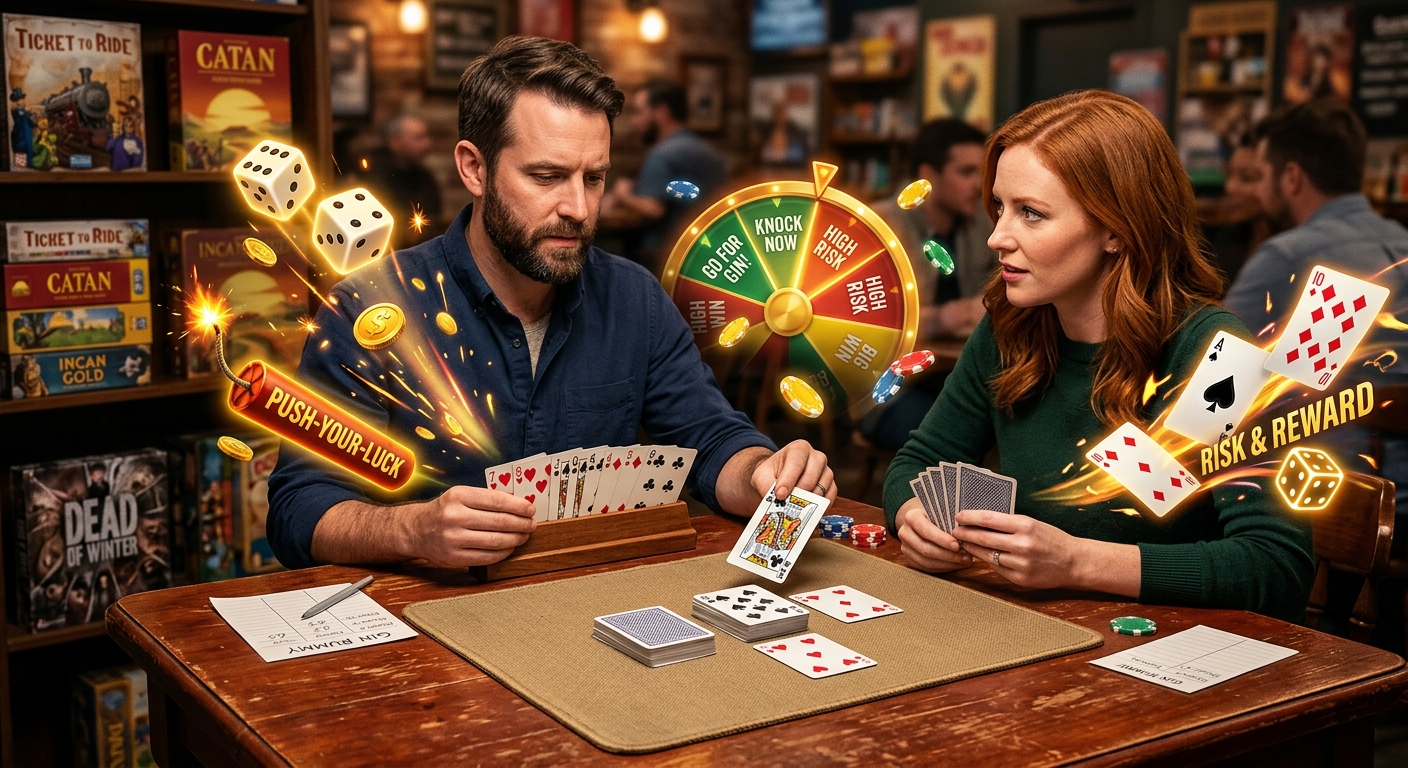
You're holding 9 points of deadwood. The card you just drew does nothing for your hand. You could knock right now and probably win. But somewhere in the back of your mind, one thought keeps surfacing: one more draw could be the card that changes everything. That tension is not a flaw. It is baked into every gin rummy hand you will ever play.
The question of whether to knock or keep drawing is the central strategic decision in gin rummy. Players who answer it well consistently outperform players who do not, even when both know the rules cold. Understanding the risk calculus behind this decision turns a reactive habit into a deliberate skill.
Strategic Knock Timing: Key Points
- The optimal knock window in most hands sits between 6 and 10 deadwood points, and players should use it more aggressively than they do.
- Discard pile patterns directly signal what your opponent is building, and that should influence your timing.
- Waiting for gin when you can already knock is one of the most common and costly habits in casual play.
The Decision That Runs Through Every Hand
Gin rummy gives each player a knock window. Once your unmatched cards, called deadwood, total 10 points or fewer, you are eligible to knock. That threshold is not a suggestion. It is the door the game opens for you. Whether you walk through it is entirely your call.
New players treat the knock option as a last resort. They want gin. They want the clean finish and the bonus points. That instinct is understandable. Gin feels like the complete version of success. But the math often disagrees. If you can knock with 8 deadwood and you choose to draw instead, you are making a bet. You are wagering the points you have already secured against the chance of something better.
Under gin rummy rules, a player who knocks and loses to an opponent with equal or fewer deadwood points gets undercut. That penalty flips the win to the other side. Staying in the hand too long, or allowing your opponent to knock first, is where the real damage happens.
The Push-Your-Luck Instinct Has a Name
There is a reason this temptation does not go away. The pull toward "one more draw" is not specific to gin rummy players. The same drive shows up in every game that asks you to decide between a known reward and a bigger, uncertain one.
Consider zombie dice for a moment. In that game, you keep rolling to collect brains, but every roll risks getting shotgunned and ending your turn with nothing. The question is always the same: are the points you have banked enough, or do you risk them chasing more? Every player at that table knows the feeling of wanting just one more roll even when the rational play is to stop. Gin rummy packages that identical pressure inside a card game. You have a knockable hand. Something better might be one draw away. You press. Your opponent knocks before you get there.
Recognizing this instinct for what it is, a psychological pull toward bigger rewards, helps you evaluate it instead of just obeying it during actual play.
What Your Deadwood Count Is Really Telling You
The deadwood number on any given turn is not just a score. It is a risk signal. Here is how to read it honestly:
- 10 deadwood: You are at the legal floor to knock. Whether to act depends entirely on your read of the opponent, not the number itself.
- 7 to 9 deadwood: This is the zone where most players should be more aggressive about knocking than they are. The marginal gain from drawing further rarely justifies the added exposure.
- 4 to 6 deadwood: You have a genuinely strong hand. The case for knocking here is compelling in most game states.
- 1 to 3 deadwood: You are one or two cards from gin. Pressing the luck makes mathematical sense here, assuming the cards you need have not already been discarded.
- 0 deadwood: You have made your hand. Knock immediately without hesitation.
The mistake most players make is treating all numbers below 10 as roughly equivalent. They are not. The value of staying in the hand decreases as your deadwood drops below 5, because the gap between where you are and gin shrinks while your exposure to being undercut or out-knocked stays real.
Discard Pile Signals That Shift the Calculation
The discard pile is not decoration. Every card in that pile is information. Skilled gin rummy players track it closely, because what has been discarded tells you what your opponent cannot possibly be using.
If you see three cards of the same rank already discarded, no one can build a set around that rank. That knowledge affects which of your deadwood cards are genuinely dead weight and which might still become part of a meld. If your opponent is discarding high-value cards in the early turns, they are almost certainly building tight and may be closer to knocking than their pace suggests.
Use discard pile observations to recalibrate your knock timing continuously. If you are sitting at 7 deadwood and both cards you need to complete your best remaining meld are already in the pile, the calculus shifts sharply. You are not three draws from gin. You are stuck. Knock earlier in that situation, not later.
How Opponent Behavior Feeds the Timing Decision
Beyond the discard pile, your opponent's behavior across a hand gives you signals worth reading. Here is a ranked sequence of behaviors to pay attention to:
- Draw pace: An opponent who draws and discards without pausing has a clear plan. Players who hesitate before discarding are still working something out.
- Pick-ups from the discard pile: When an opponent takes from the discard pile instead of the stock, they are confirming a meld. This signals a hand coming together fast.
- High-value discards early: Tossing face cards and aces in the first few turns typically means they are building low. A hand that builds low can knock sooner.
- Consistent draws from stock only: If your opponent never picks from the discard pile, they may be on a narrow meld track that depends on specific draws. Their hand might be stalling.
- Late hesitation: A long pause before discarding deep into the hand often means they are weighing whether to knock. That is your cue to stop waiting.
None of these signals are foolproof. Experienced opponents can fake tempo. But in both casual and competitive play, most tells are genuine. Using them gives you a meaningful edge over players who only look at their own cards.
Knock Timing Mapped to Common Game States
When the Situation Should Override Your Instinct
The table below maps common game states to the knock decision that holds up most often in practice. These are not rules. They are calibrated defaults that account for the context around your hand, not just the cards in it.
| Game State | Deadwood Range | Recommended Action |
|---|---|---|
| Opponent drawing fast, picking from pile | 6 to 10 | Knock now |
| Opponent discarding face cards early | 7 to 10 | Knock now |
| Cards you need are already in the discard pile | 5 to 9 | Knock now |
| Opponent hesitating, rarely picking from pile | 2 to 5 | Press for gin |
| Stock pile running low | Any knockable count | Knock immediately |
Making Peace with the Good-Enough Hand
The hardest part of knock timing is not the math. It is the psychology. There is something in most players that resists settling for a knockable hand when a perfect hand still seems possible. That resistance is exactly what experienced opponents count on. They draw calmly, they build steadily, and they let your hesitation work in their favor.
Knowing your deadwood number is not enough on its own. Knowing what the discard pile reveals is not enough either. Real knock-timing discipline comes from combining those reads with an honest accounting of where your opponent likely stands. When that combination points toward knocking, the best move is almost always to do it without second-guessing.
The players who win consistently are not the ones who chase gin every hand. They are the ones who accept the smaller win without flinching, bank the points, and trust that discipline over time adds up to something the "one more draw" gamblers never quite reach.
The tension between knocking and drawing will never fully disappear. That is part of what makes gin rummy worth returning to. But players who respect that tension, who study it, read real signals, and act on them rather than wishful thinking, those are the players who sit on the right side of the score sheet most nights.